
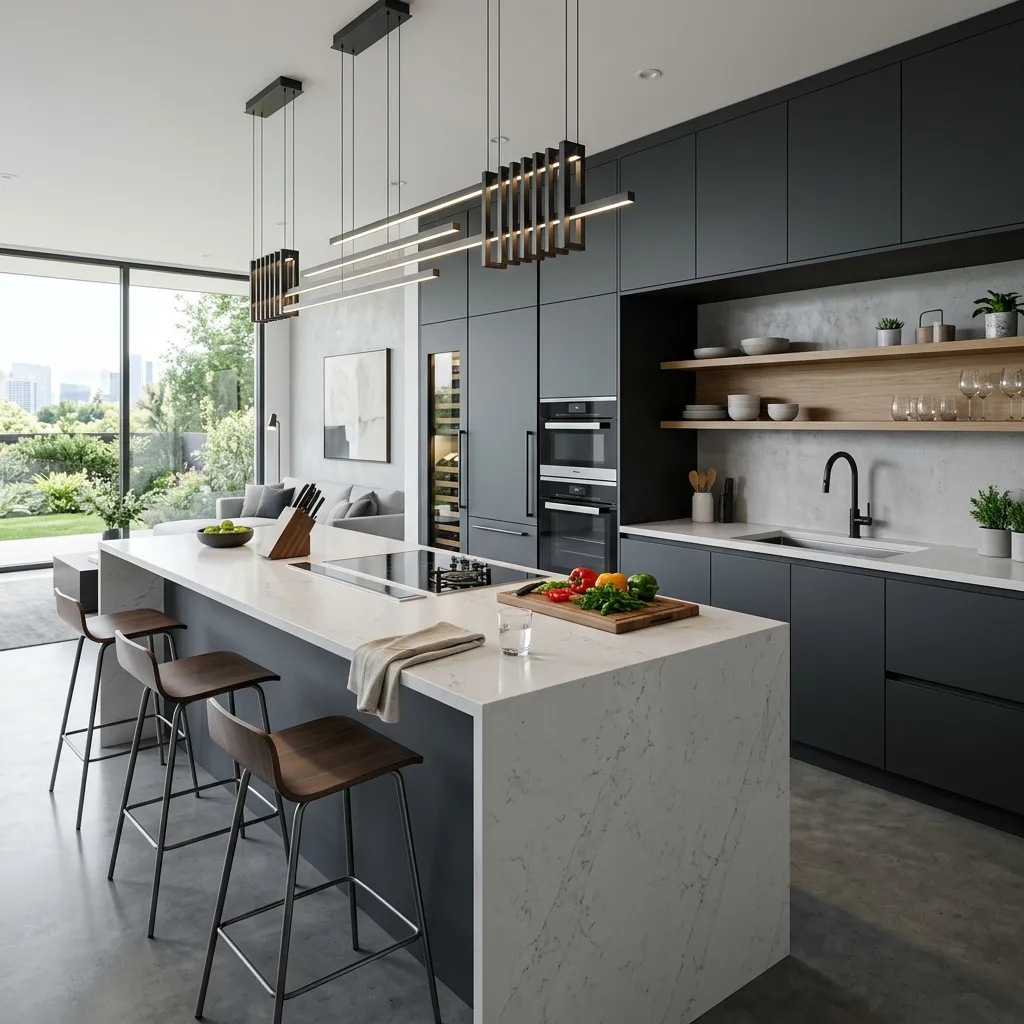
Choosing between Acrylic and PU finish for your modular kitchen? Learn the pros, cons, and which material survives Ahmedabad's climate best.
Follow Purn Interiors
Add us to your preferred sources to see our design tips first in Google's AI Overview.
When designing a premium modular kitchen in Ahmedabad, one of the most common dilemmas homeowners face is choosing the right finish for their cabinetry. The finish not only dictates the entire aesthetic of your kitchen but also determines its longevity, especially in Ahmedabad's hot and dusty climate.
The two most sought-after premium finishes are Acrylic and PU (Polyurethane). But which one is right for your home? Let's break it down.
What is an Acrylic Finish?
Acrylic is a non-toxic, reflective high-gloss finish that gives cabinets a smooth, mirror-like appearance. It comes in the form of sheets that are pasted onto an MDF, HDHMR, or plywood substrate, and the edges are sealed with edge-banding tape.
Pros of Acrylic:
- Ultra-Glossy Look: It provides a flawless, reflective sheen that makes smaller kitchens feel more spacious.
- Color Retention: Acrylic does not fade easily under UV light, making it ideal if your kitchen gets a lot of direct sunlight.
- Scratch Resistance: It is highly resistant to daily wear and tear.
Cons of Acrylic:
- Edge Banding: The edges where the acrylic sheet meets the board require edge banding, which can sometimes accumulate dirt over years if not maintained.
- Fingerprints: The high-gloss surface means fingerprints and smudges are highly visible.
What is a PU (Polyurethane) Finish?
Follow Purn Interiors on Google
Add us to your preferred sources to never miss our luxury interior guides and project walk-throughs.
PU is an acrylic-based paint applied directly over the shutter (usually HDHMR or MDF) in multiple coats. Because it is sprayed on and buffed, it provides a completely seamless finish with no edge banding.
Pros of PU Finish:
- Seamless Elegance: With no edge banding, PU looks incredibly luxurious and continuous.
- Versatility: Unlike Acrylic (which is only glossy), PU is available in high-gloss, matte, and even metallic finishes.
- Customization: You can mix any custom color or shade to match your exact interior palette.
- Groove Friendly: If you want profile handles (G-profile or J-pull) routed directly into the wood, PU covers the grooves flawlessly.
Cons of PU Finish:
- Cost: PU is significantly more expensive and time-consuming to apply than Acrylic due to the intensive polishing process.
- Maintenance: While durable, deep scratches on a PU surface can be harder to repair than simply replacing an acrylic sheet.
The Verdict for Ahmedabad Homes
If you have a busy household with heavy daily cooking, Acrylic is a highly durable and slightly more budget-friendly option that withstands intense use. However, if you are designing a luxury villa or high-end 3BHK and want an ultra-premium, matte, seamless look, PU finish is the undisputed winner.
At Purn Interiors, we specialize in bespoke Modular Kitchen Interior Design. Our experts help you choose the right base materials (like BWP Marine Plywood or HDHMR) and the perfect finish to ensure your kitchen looks stunning and lasts for decades.
Book a free consultation today to start designing the kitchen of your dreams.

About the Author
Saurabh Jain
A visionary Civil Engineer and INIFD-certified interior designer, Saurabh Jain brings 12+ years of architectural mastery to Purn Interiors. Having successfully delivered over 500 luxury projects for local and international clients, he is a multiple award-winner recognized for his 'Sensory Engineering' approach to high-end residential and commercial spaces.
View Studio ProfileRead Time
2 MIN
Publication
Q3 2026
Newsletter
Receive curated design insights directly.